Visit the Village Online
1840s Log Home
1844 Stone Academy
Blacksmith & Carpentry Shop
Heritage Center Museum
Railroad Depot
Sister City Garden
1840s Log Home
This 1840s log home was acquired from an area near Weston, Ohio, dismantled and brought to its present location in the Sylvania Historical Village. Reconstructed with new windows and roof, this log home represents the type of home inhabited by the first Sylvania settlers, a two-story home with the family living quarters on the main floor and a sleeping loft above.
Costumed interpreters demonstrate how early Sylvania settlers cooked, preserved food, made soap, fabric, clothing and floor coverings, and carried out the routine tasks of daily living. During the Log Home school program, students receive a unique hands-on experience, including trying on period clothing
.
.
1844 Stone Academy
In this replica of Sylvania’s early Stone Academy, costumed interpreters recreate the experience of learning to read, write and “cipher,” or use arithmetic, as the children of Sylvania did in the 1840s.
Visitors also hear about Sylvania’s role in the historic Underground Railroad. Local residents acted as “conductors,” hiding slaves from their "owners" and bounty hunters until they could move on to the next “station,” making their way to safety and freedom in Canada.
.
Blacksmith & Carpentry Shop
Housed in a replica of a barn typical of 1840s Northwest Ohio, this side-by-side shop is where adult tours and schoolchildren experience the tools used by craftsmen and the products they made for Sylvania’s earlier residents.
In the blacksmith’s shop, visitors learn about many of the cast and formed products used in everyday home life and transportation in early Sylvania, from door handles and pot hooks to horseshoes and carriage parts. Blacksmithing demonstrations are available for some special events.
In the carpentry area, visitors learn how tradesmen used ingenious hand tools and learned skills to produce furniture, wagon wheels, household goods and much more.
.
Sylvania Heritage Center Museum
The Uriah Cooke Home
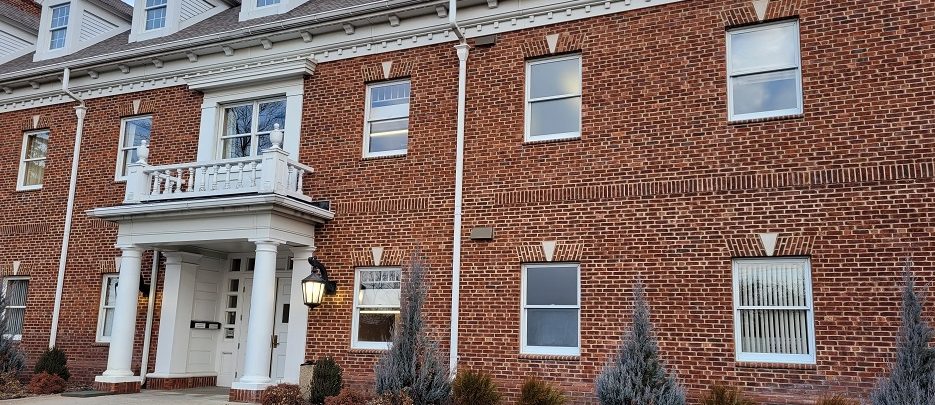
The structure that now houses the Sylvania Heritage Center Museum was the home of Dr. Uriah A. Cooke. Originally purchased in 1897 and renovated in 1902, the residence also was Dr. Cooke’s medical office from 1897 – 1942.
Dr. Cooke served on the Sylvania school board and helped found the Sylvania Savings Bank. He was twice appointed medical director for the poor in Sylvania, from 1927 – 1930 and 1934 – 1938. He also attended the Methodist Episcopal Church in Sylvania.
After Dr. Cooke’s death in 1942, the home remained in the Cooke family until 1989. The city purchased the home in 1992. Local nonprofit organizations submitted ideas for the home’s use. The museum suggestion was chosen, and today the building is home to the Sylvania Area Historical Society, VFW Post 3310 and the Toledo Area Miniature Enthusiasts, as well as the Sylvania Historical Village.
Many architectural features of Dr. Cooke’s medical office are still visible in the home. The original physician’s office and apothecary remain intact.
The three-story home has 10 rooms on the first floor, four bedrooms and a storage area on the second floor and a third floor with hardwood flooring and window seats. This space was used as a billiards room and housed a cistern which supplied gravity-fed water. A basement with six rooms was added during the 1902 remodeling.
In the spacious entry room, an ornate fireplace and carved wood staircase welcomed visitors into the Cooke home. A hallway off the entry room leads to the three-room suite that served as the doctor’s office.
The oak hardwood floor extends into the dining room, which features an intricate ceiling treatment, a window seat and pocket door with a faux finish. The light fixture in the dining room is not original to the house, but is reminiscent of the era.
The pantry off the dining room features floor-to-ceiling storage, typical of the era. A small work area includes a pull-out work surface and flour and sugar bins.
The only bathroom, circa 1915, is located off the dining room. The room features original tiles and a claw-foot cast iron tub.
Attached to the rear of the house is a hand-hewn barn from the 1860s. The two-room structure housed the doctor’s horse and buggy and included a truly unique feature – an indoor outhouse.
Railroad Depot
The showpiece of the Historical Village is the genuine railroad depot building that served Sylvania residents for 98 years, from 1858 to 1956. It is the oldest train depot in existence in the State of Ohio.
From this single small building, Sylvania sent its men to five wars over nearly a century – the Civil War, Spanish-American War, World Wars I & II, and the Korean War. It served through the periods of the fastest growth the U.S. has ever known, with the invention of the telegraph, electricity, telephones, the automobile, the natural gas home furnace and indoor plumbing.
Built in 1858, the Sylvania Depot was donated by Gene Paul and Jack Newton in 1996 and moved to the Village in March 1997. It played a vital role in hundreds of thousands of lives, and plays an invaluable part in bringing Sylvania’s transportation history to life.
The building has not been altered except to move two windows and a door for better viewing. Artifacts are displayed inside the building.
Locomotive Engine & Caboose
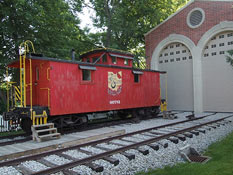
In 2005 the Village was given a 10-ton, fully restored electric locomotive built for the Toledo & Western Interurban Railroad, and a caboose similar to one used by the Toledo, Angola and Western Railroad. With this donation, the Village is committed to building a structure to preserve them – a replica of the Toledo Interurban “car barn” with tracks to allow the cars to move in and out of the building for viewing and classes.
This contribution makes our Historical Village unique – the only one where you can see Ohio’s oldest railroad depot, a fully restored electric railway engine and an example of a short-track freight railroad, as well as an original bed of the Erie & Kalamazoo Railroad.
Sylvania's Ties to the Railroad
Almost since its inception, Sylvania has had a close and vital association with rail transportation. In 1835, the Erie & Kalamazoo Railroad Company won the right to construct a rail line between Toledo, Ohio, and Adrian, MI. The rail line was the first line west of the Allegheny Mountains. The first railroad cars were pulled by horses!
Sylvania was chosen for a stop because of its abundant water supply. The first locomotive traveled through Sylvania in 1837, and an advertisement in the Toledo Blade that year proclaimed:
Emigrants and others destined for Indiana, Illinois and western Michigan WILL SAVE TWO DAYS and the corresponding expense by taking this route in preference to the more lengthened, tedious and expensive route heretofore traveled.
The cost for the Toledo-to-Sylvania leg of the journey was $.50; from Sylvania to Adrian, $1.50. In Adrian, the train connected with the Michigan Southern Railway. But travelers, especially ladies, were cautioned to be on their guard. The words below are from a sign posted in a railroad depot – maybe even Sylvania’s.
Warning, there are wicked men and women in railway stations and other public places who seek to lead girls astray. Young women coming from the country and small towns should be very careful who's [sic] advice they follow.
For more information about Sylvania's railroad past, look for the book Next Stop, by Gaye Gindy, at your local library.
Sister City Garden
The Sister City Garden is a beautiful and peaceful setting on the grounds of the Sylvania Historical Village. The garden celebrates the alliance with our sister city, Woodstock in Ontario, Canada. Its three-season floral displays ensure dazzling colors whenever you visit.
This soothing, natural environment is perfect for a quiet picnic anytime, and a beautiful location for weddings, bridal or baby showers. Available for private rental, there is seating for 32 at cafe tables and picnic-style tables. Call 419-882-4865 for more information.
Visit our sister city, Woodstock, Ontario.